

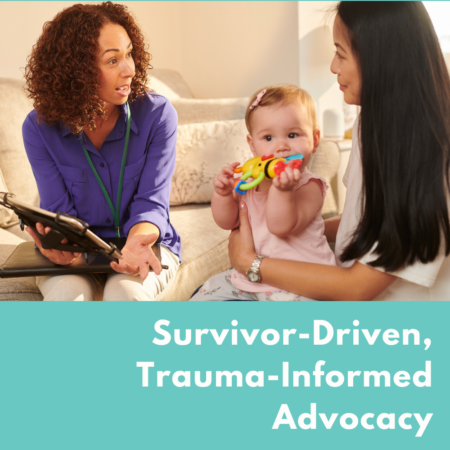
Survivor-driven, trauma-informed advocacy means working in partnership with survivors. Advocacy is focused on safety and supporting survivors to rebuild control over their lives. Survivors lead the process, choose their own goals, and define what is going to be safer for themselves.
Survivor-driven, trauma-informed advocacy
Providing survivor-driven, not program-driven services is a cornerstone of DV Housing First. The below video explains this pillar of the DV Housing First service model.
- Use this assessment tool to review your advocacy practices.
- Take some time to review your policies and procedures (shelter, transitional housing, permanent housing) and identify what is driven by program requirements, what is required by funders, and what can change to become more survivor-driven.
- View this webinar from Jill Davies explaining victim-defined advocacy.
Examples of housing and program policies and procedures that are survivor-driven
Mobile advocacy
Mobile advocates meet survivors in the location of their choice. This can be at the park, in a coffee shop, or survivor’s home. It also includes accompanying survivors to housing, employment, and child welfare appointments. Connecting with and accompanying survivors can be in an advocate’s personal vehicle, an agency-owned vehicle, bus, taxi, or ride share vehicles. An advocate does not have to drive in order to be a mobile advocate.
Advocate safety and survivor confidentiality are concerns that may need to be addressed when practicing mobile advocacy. It is important to know that mobile advocacy is not a crisis response.
- See what advocates and directors have to say about implementing mobile advocacy.
- Use the Safety Planning Policy and Protocol to guide your discussion on creating mobile advocacy policies.
- Tips and tools for mobile advocacy.
- Sample advocate job descriptions.
Review
- Liability insurance: If an advocate is comfortable using their own vehicle for mobile advocacy, they should make sure that the state-required minimum amount for automobile is in place. If the advocate routinely transports people (anything from personal carpools to friends, family, and neighbors), it might be a good idea to increase the amount of liability insurance on the vehicle. If the agency requests that a personal vehicle is used, the agency should look into providing the additional coverage for staff.
- Mileage reimbursement: Have a mileage reimbursement form that advocates know how to fill out and submit. Make sure you provide reimbursement in a timely manner.
- Scheduling and communication: ave a system set up with advocates and supervisors so staff knows where and how to locate and connect with each other. Allow advocates to set schedules that meet the needs of survivors.
- Technology: Equip advocates with agency computers and cell phones and review best practices for mobile devices.
- Staffing patterns: Organize your staff so that they are not required to be based in facilities.
- Hiring and supervision approaches: Hire advocates that have the desire and skills to work out of the office and in the community. Establish practices that allow for supervision to occur remotely and flexibly and that trusts and supports advocates to be out of the office.