
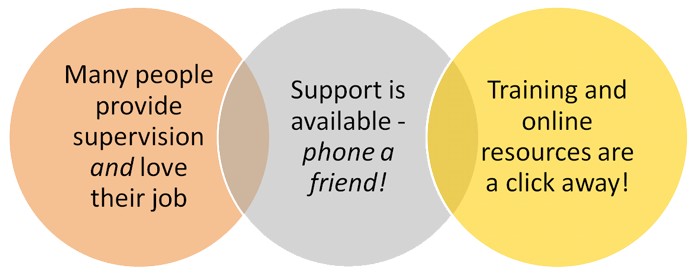
Supervision is a collaborative process and is ultimately about making a connection. The good news is that there is no secret to supervision. The reality is that:
Welcome to the world of supervision!
Whether you come to this role from within your organization or from outside it, someone saw that you have what it takes to lead people at an anti-violence program. Thank you for saying yes.
You have answered a higher calling: To support and guide people to provide quality, survivor-driven advocacy services and prevention. To foster a humane workplace and trauma-informed organizational culture. To promote safety, dignity, and healing for survivors from all walks of life. To help build a future where all people can live and love freely without fear, in community.
Managing people and programming in victim services organizations can be incredibly fulfilling…and can also be overwhelming, stressful, and incredibly hard. As a wise supervisor in our state says, “We’re already working hard. Working harder won’t help. So let’s work smarter. And wiser. Let’s be honest about how our work affects us. Let’s be bold about asking for and accepting help. We can’t help others if we’re burned out.” Whether you come to this work as a first-time or seasoned supervisor, the following resources are here to help you work smarter, wiser, and more boldly, and to connect.
Training Hours on Supervision:
You may read and engage with this self-study guide to help satisfy the initial and annual supervisor training requirements for Washington state-contracted domestic violence and sexual assault programs. There are over 50 hours of content here, including links to self-study resources to read, listen to, or watch. We’ve marked below where you can meet the initial five (5) hour supervisor training requirement for state-contracted domestic violence programs.
Keep track of your self-study hours and print out the sections you completed (including links to resources or online courses). Please refer to your organization’s contract to check on specific requirements.
A note for sexual assault program supervisors:
This content is adapted from materials developed over time by WSCADVSA. In the future, we hope to update the guide to reflect the specific needs and experiences of supervising staff at SA programs, and welcome your feedback on that.
Let’s get started:
The following resources provide several forms of self-study for supervisors, both new and veteran. We’ve assembled a variety of materials to read, to listen to, and to watch, all on various aspects of supervision. We’ve grouped materials under various headings. Start where it makes sense to you, and pick and choose. It’s not an exhaustive list by any means, so we’ve included links to relevant sites like Ask A Manager, Nonprofit AF, Nonprofits are Messy, Blue Avocado, and online communities like Nonprofit Executive Director Happy Hour where you can find answers to thousands of questions and connect with other supervisors who are dealing with some of the same issues you are, especially at nonprofits
Leadership Skills for New Supervisors
Once you agree to supervise, get clear on your role. Effective supervisors connect with staff and help them do their best, while setting healthy expectations and boundaries, ensuring quality survivor-driven services, and mutual accountability. A big part of the job is solving problems and dealing with conflict. Staying connected, clear communication, building trust, and managing yourself are all key.
Many supervisors in our field come to the role from within their organization. This is fantastic! You already have organizational knowledge. You’ve likely been an advocate. You know firsthand what your coworkers do. As a supervisor, your focus shifts from executing individual tasks as a team member, to empowering staff to get their work done. And many supervisors still do a lot of direct services. Juggling this with your new role is not easy.
One long time supervisor shared this daily reminder that she had on her desk, something she cut out of a paper newsletter (remember those?) years ago: Manage people first; do your own work second. With time, she reports, she learned people management skills, like expectation setting, delegation, clearing roadblocks, and getting out of people’s way so they could do their work while being their biggest champion. These skills can really only be honed on the job, and there are plenty of folks in our movement who are here to help. Acknowledge your feelings of overwhelm, and let them float on. Then, reach out to your peers or the Coalition. People like to help. Ask!
Even when you have good relationships with the folks you work with, supervising peers can be awkward. Here’s some advice for first-time managers. If you’re replacing a team leader everyone loved, check out this article on successfully leading a team that someone else built.
Let’s talk a little about imposter syndrome, that feeling that you’re not qualified, don’t belong, don’t know what to do, and feeling like people are going to think you’re a fraud. This dynamic is common in our sector, especially if you are a person of color, immigrant, woman, belong to other historically marginalized groups, or don’t have a college degree or financial comfort. Check out The Nonprofit Fixer for tips on how to reframe your mindset and stay connected to WSCADVSA for leadership development opportunities.
Finally, self-care, care for your team, and dealing with trauma. You’ve learned about and likely experienced secondary trauma. You don’t suddenly stop needing self-care as a supervisor. Supervisors need it, too, and may actually need more. The superhero cape can get even heavier for supervisors; check out this quick read, complete with illustrations.
Many people have found help and affirmation from relatable books written by people in our movement to end violence:
- Trauma Stewardship: An Everyday Guide to Caring for Self While Caring for Others by Laura Vandernoot Lipsky with Connie Burk
- Organizational Trauma and Healing (check out free online tools) by Pat Vivian and Shana Hormann (based in part on their work with rape crisis programs)
What does a supervisor of survivor advocates do?
If you work at a domestic violence survivor program, here are your responsibilities as outlined in Chapter 388-61A of the Revised Code of Washington. (As noted above, in the future, we hope to update the guide to reflect the specific needs and experiences of supervising staff at sexual assault programs.)
Need a few quick tips to jump start your supervision style? Take a look at our handy Super Supervision guide.
If you read and watch all the resources above, not including the books – consider that extra credit – you’ll have completed at least 4 hours of self-study.
Hiring great advocates: It all starts here
Our online course is an overview on how to identify and hire the right employee for your domestic violence program. We’ll cover practical tools and tips for getting ready to hire as well as preparing you to run an effective hiring process. (Note: Completing this course constitutes 5 self-study hours.)
Blue Avocado is a free online magazine with hundreds of articles written by nonprofit leaders, for nonprofit leaders. Check out this article on improving equity and increasing effectiveness in the hiring process. Here’s another one on reducing unconscious bias in the recruiting process. (These two articles add another 25 minutes of self-study supervisory training.)
And our recorded webinar on staff retention is a great follow-up: because staff retention is critical and hiring is expensive (And get 2 more training hours.)
Job Coaching & Training Advocates
One of your most important roles is to orient and train new advocates. You play a key role in helping advocates get off to a good start and avoid common traps and burn-out.
Advocates need to understand survivor-driven advocacy, where their job with survivors is to:
- share power
- respect their strengths, cultures, and community
- accept and meet survivors where they are
… as well as to model and contribute to your program being:
- flexible and for the whole person, not just the abuse
- survivor-driven, not program-driven
- culturally competent (see our multi-cultural survivor advocacy assessment guide)
- action-oriented
Here are a few resources to get started:
- Talk about rescuing and taking off our superhero capes. Why is rescuing harmful to our goals of freedom and liberty? How can it re-enforce the abuser’s power? What situations might trigger a rescue response for you, and how will you get support?
- History of the Domestic Violence Movement is a WSCADVSA training that provides excellent context and invites the participant to reflect on their own experiences and hopes for the future.
- Share principles of survivor-centered advocacy, and unintended consequences of common practices done in the name of “keeping survivors safe.” Check out our Survivor-Defined Advocacy webinar.
- Discuss common myths about the advocate’s role. Are you ready to talk about why the following statements are not only incorrect but deeply contrary to survivor-driven advocacy?
- “Protection orders make survivors safe and I should encourage survivors to get one.”
- “I should always encourage my clients to cooperate with prosecutors.”
- “My goal should be to help survivors leave the abuser since leaving is the safest and best outcome.”
- “Since survivors are traumatized, they can’t make good decisions until I empower them.”
- “DV survivors who reunite with their abuser put their kids at risk.”
(Not sure how to answer? Check out Mission-focused management and empowerment practice: A handbook for Executive Directors of DV Programs by Cris Sullivan, Pennsylvania Coalition Against Domestic Violence; see pages 29-31.)
- Here’s an exercise from VAWnet that provides an opportunity for advocates to define and practice peer supervision.
- Illustrate how domestic violence advocacy services that aren’t survivor-driven can replicate power and control dynamics, with these cartoon scenario videos created by WSCADV/SA:
- Provide training and job shadowing opportunities with a focus on core principles. Send new advocates to WSCADVSA’s Advocacy for Rookies training or to another program for training or job shadowing with experienced advocates. Watch our calendar for training offerings.
Supervising for Survivor-Driven, Trauma-Informed Advocacy
Trauma-Informed Supervision
Many of us have been drawn to the movement because of our own or our family experiences of sexual assault, domestic violence, or historical trauma. Abuse and trauma affect how people experience power and authority. Many staff coming to work at a domestic violence or sexual assault program with negative experiences with power in childhood, school, religious congregations, dating or intimate relationships, or jobs. These negative experiences range from unfairness to abuse to violence by people trusted with authority.
If you’ve ever heard, “You’re acting like my abuser” from an employee, you are not alone. If you have ever witnessed coworkers acting in ways that seem like flight, fight, freeze, or fawning, or had those responses yourself on the job, you are not alone.
In our movement, we have a lot of work to do to untangle abuse (bad) from authority (part of both the advocate and supervisor job roles), power (neutral), and empowerment (good).
Learning about trauma-informed supervision practices can help. Here are a few resources:
- Organizational Trauma and Healing book and free online tools by Pat Vivian and Shana Hormann (based in part in their work with rape crisis and domestic violence programs)
- Trauma-Informed Supervision recorded webinar from the Nonprofit Association of Washington
- Blue Avocado’s article on Unmasking the Silent Impact of Trauma in Nonprofits discusses the consequences of ignoring individual and collective trauma and outlines some steps for cultural change. Also included is a trauma-informed organizational assessment.
- The Trauma-Informed Supervision Guide developed by the Pennsylvania Coalition on Rape (PCAR) seeks to help supervisors create an environment that acknowledges and “normalizes” the effects of working with trauma survivors so that advocates feel supported and encouraged to address their needs. The guide has lots of supervision “how-tos” and best practices.
- How You Can Create a Culture of Care at Work focuses on the emotional labor of being “othered” and how to build a compassionate workplace.
Survivor-Driven Advocacy Supervision
To carry out survivor-driven advocacy practices, organizations and staff need intentional supervision.
- View this webinar from Jill Davies explaining victim-defined advocacy.
- The Trauma-Informed Self-Assessment Guide is a tool to review your advocacy practices.
- Take some time to review your policies and procedures (shelter, transitional housing, permanent housing) and identify what is driven by program requirements, what is required by funders, and what can change to become more survivor-driven.
Nuts and Bolts of Supervision
So how do you actually supervise? Mixed feelings (and fear and anxiety!) are normal.
- If lack of confidence is ruining your work day, try this healthy dose of resiliency practices, self-care, and work journaling.
- Find new peers and guidance on being the boss.
- Don’t be the manager who doesn’t manage.
- Thinking about being a “cool boss”? Rethink that.
- Stay involved and support staff without micro-managing.
- Check out nonprofit leader Joan Garry’s post, the Secret to Managing Nonprofit Staff.
- Joan and the amazing Rita Sever, have a good podcast about supervision as leadership, and management. This is a good one for your drive to and from work – about 53 minutes in length.
- Check out Supervision Matters: 100 Bite-Sized Ideas to Transform You and Your Team by Rita Sever for tips on how to become a more effective supervisor and advice on how to be clear about expectations, giving helpful feedback, and manage yourself.
- Remote workers? Here are some tips for managing remote staff and hybrid teams.
Leadership Skills for Supervisors
Communication: The Root of It All
- Check out Simon Sinek’s short video on the Art of Listening.
- And here’s a brief Ted-Ed Talk on the 4 Things Great Listeners Know.
- Miscommunication happens, too. Katherine Hampsten offers some wisdom on the topic in this brief Ted-Ed Talk.
- Not sure what to say? Try some questions to get beneath the surface.
Conflict
Conflict can be healthy; it can also be uncomfortable and damaging. Managing conflict is a central part of the supervisor’s role. Here are some resources in how to deal with it.
- Understand different conflict styles on your staff team.
- Here’s an article on de-escalating conflict from a risk-management perspective.
- Nonprofit guru Joan Garry takes on the topic in these three podcasts:
- How to have productive conversations in polarizing conflict.
- This animated video uses the drama triangle and the empowerment dynamic to help teams to work from a place of purpose and presence.
Feedback
Meaningful feedback boosts employee engagement and makes you a better supervisor. It also makes performance appraisal a dynamic process.
- Regular one-on-ones are a cornerstone of supervision.
- Here’s a resource to use to set goals together and ask good questions.
- Shari Harley, author of How to Say Anything to Anyone, has helpful information on giving staff effective feedback. Check out her video on Giving Feedback for Strong Performance
Staff Evaluation
In a organizational culture of ongoing meaningful feedback, there is no need to dread annual performance reviews.
- Check out this webinar on improving employee performance evaluations.
- Blue Avocado weighs in on the topic with this article on Designing a Values-based Performance Appraisal System.
- And this one on how managers can improve the performance review process.
Multi-Cultural Supervision
Victim-blaming, isolation, and discrimination hand power to abusers. No one should face a closed door when they seek life-saving help, or be told that they don’t deserve better. Victim services are for survivors from all walks of life. Racism and other forms of racial bias, discrimination, and inequality in our society lead to higher rates of violence and lack of a way out for many survivors, including women of color, LGBTQ+ people, immigrants, and many others.
As a supervisor, you can influence and help create a healthy organizational culture. You can be a role model in normalizing conversations about how everyone can make a difference, and take steps to create more fair and equal workplaces and survivor services. Check out:
- Unrig the Game: What Women of Color Can Teach Everyone About Winning by Vanessa Priya Daniel, featuring interviews with 45 movement leaders and insights for all.
- Vu Le from the blog Nonprofit AF says, “Undoing racism and other forms of injustice is a practice we must do every day, like brushing our teeth.“
- In this podcast, Building Belonging When DEI Feels Like a Four-Letter Word, Joan Garry and Dr. Kiki Ramsey speak to staff leaders carrying the weight of a mission that feels more urgent and more threatened than ever before, and how to build a sense of belonging.
- Our immigrant co-workers are not doing okay but we can all make a difference. Check out resources by the National Immigration Law Center about what to do if immigration comes to your workplace and this resource list from the Alliance for Immigrant Survivors. One section has resources specific to victim services.
- As supervisors, we can take steps to support safety and inclusion for our LGBTQ+ colleagues, as backlash, violence, and laws targeting LGBTQ+ people continue to rise. Check out Understanding Best Practices in LGBTQ+ Inclusion, a toolkit from the Human Rights Campaign on building respectful, inclusive workplaces where everyone can thrive.
- As a staff leader, you make a big difference just by talking in the workplace about what is happening to Black and Brown people in our country today.
- Check out Leading for Justice: Supervision, HR, and Culture, by Rita Sever.
More Resources
- Ask A Manager: A popular online advice column for both managers and staff, by a former national nonprofit executive. Check out topic collections on “being the boss,” supervising, communication, resolving conflict, and how to get things done.
- Nonprofit AF: Gets to the heart of nonprofits and philanthropy with humor and a “no-BS approach” by Vu Le.
- Executive Directors Happy Hour Facebook group, an international peer support group for nonprofit E.D.s, is a place to connect, ask questions, share advice, and collectively move our sector toward one that is more humane and fair.
- Nonprofits Are Messy podcast and blog by Joan Garry.
- Blue Avocado is a free online magazine with hundreds of articles written by nonprofit leaders for nonprofit leaders. Here’s a link to the HR and Employment Issues section of the site.
Thanks for reading. We love hearing your feedback and ideas. Reach out to your Coalition if you are struggling. You are not alone.