
Advocates warn that without budget action, survivors will face closed doors, unanswered phones, and permanent loss of services
FOR IMMEDIATE RELEASE
OLYMPIA, February 9 — Advocates across Washington are urging state legislators to act now to stabilize funding for crime victim services, warning that without action in the SFY27 budget, survivors of domestic violence, sexual assault, child abuse, and other violent crimes will lose access to help when they need it most.
Washington has said that survivors should not have to endure violence, and that help should be there when they reach out. This year’s budget is where that promise is either sustained or withdrawn.
“This is not an expansion request,” said Sherrie Tinoco, Managing Director of Strategy and Public Policy at the Washington State Coalition Against Domestic Violence & Sexual Assault. “It’s about preventing permanent loss of services that survivors rely on in real time. When funding is unstable, services don’t slowly shrink, they disappear. Survivors encounter closed doors at the most dangerous moments of their lives.”
Federal funding through the Victims of Crime Act (VOCA) has declined by more than 70 percent in recent years. Temporary state funding that has kept programs afloat is set to expire, leaving Washington’s crime victim services system at risk of permanent contraction.
Crime victim services are core public safety infrastructure. They make it possible for survivors to escape violence, for children to disclose abuse in trauma informed settings, and for communities to intervene before harm escalates. When these services disappear, the impacts show up immediately in courts, hospitals, schools, and law enforcement.‑informed settings, and for communities to intervene before harm escalates. When these services disappear, the impacts show up immediately in courts, hospitals, schools, and law enforcement.
Across the state, advocates continue to show up — answering crisis lines, coordinating safety planning, and supporting survivors through the legal system. But no amount of dedication can replace predictable funding.
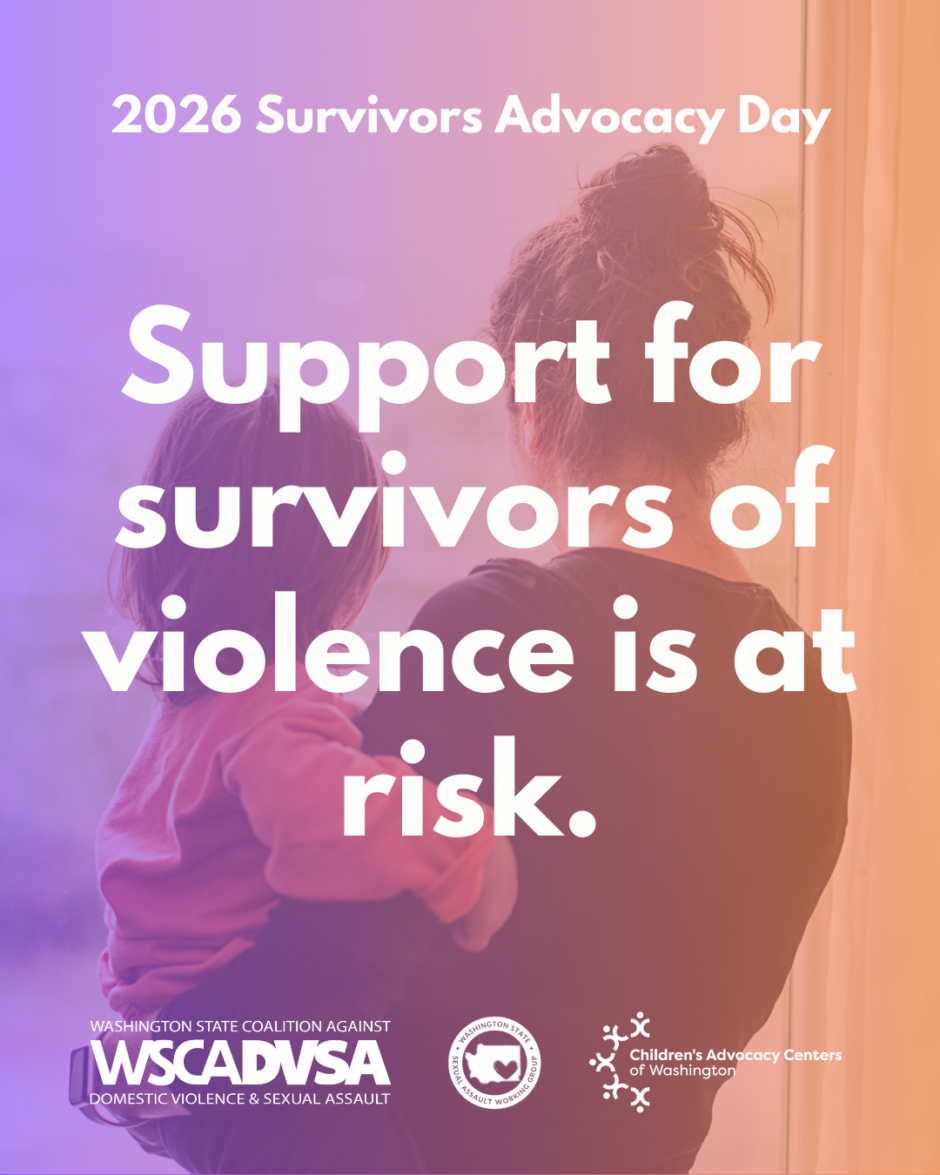
On January 27, 150 advocates from across Washington gathered in Olympia to urge legislators to include $21.3 million in the SFY27 Washington State Budget to stabilize crime victim services statewide and prevent permanent loss of access for survivors.
“This budget decision determines whether help is there when survivors reach out,” said Tinoco. “The stakes could not be clearer.”
For more information or to schedule an interview:
Elizabeth Montoya
Communications & Media, WSCADV
elizabeth@wscadv.org | (206) 600‑6324
Roshelle Cleland
Director of Public Policy, WSCADV
roshelle@wscadv.org | (206) 600‑6317
About the Washington State Coalition Against Domestic Violence & Sexual Assault
Founded in 1990 by survivors of domestic violence and their allies, the Washington State Coalition Against Domestic Violence & Sexual Assault (WSCADV) is a non-profit network of over 70 survivor advocacy programs across the state of Washington. WSCADV improves how communities respond to domestic and sexual violence and works to create a world where all people can live and love without fear. WSCADV’s work includes engaging the public to prevent violence, producing educational tools, training and technical assistance for domestic violence and sexual assault advocacy programs, and policy advocacy. To learn more, please visit wscadv.org.